The Hidden Risks of Burning Documents: Why Mobile Shredding is the Safer Choice
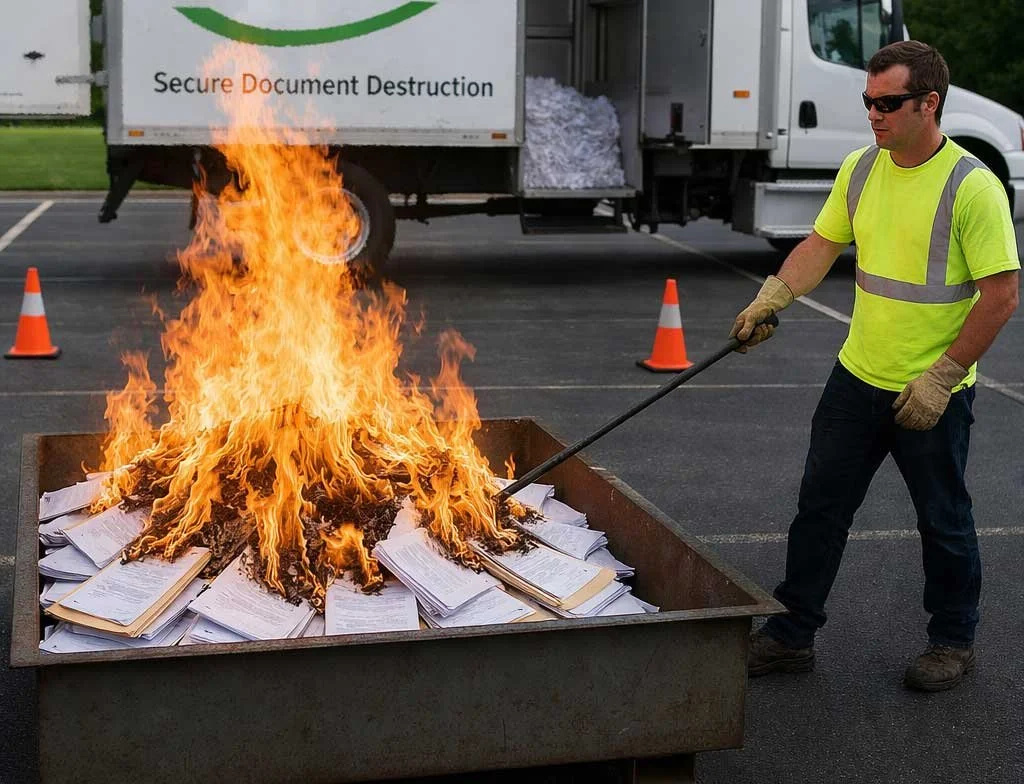
A quick burn can feel like the simplest way to clear out old paperwork. Yet for many households and small businesses, the safest approach is mobile document shredding services that destroy information on-site/off-site and leave far less to chance. Burning can create privacy gaps, safety hazards, and a mess of compliance headaches that only show up when it’s too late.
Why people still burn documents (and why it feels convenient)
Most of us keep a “paper pile” that grows quietly: bank letters, old bills, printed emails, school forms, Medicare statements, warranty paperwork.
When the pile finally gets tackled, burning seems tidy. It’s fast, it looks final, and it avoids sorting, bagging, and multiple bin nights.
It also carries a certain old-school logic: if the paper is ash, the problem is solved. The trouble is that real-world burning rarely produces clean, complete ash, especially if the stack is thick, damp, stapled, glossy, or packed tight. That’s where the risks start.
The hidden risks of burning documents
1. Fire and safety risks
Sydney homes and offices aren’t exactly built around safe incineration. Even when a fire is small, drifting embers and sudden gusts can catch people off guard.
Fire authorities also issue bans and restrictions during high-risk periods, and conditions can change quickly.
There’s also the simple fact that many backyard fire setups are only meant for certain fuels. In NSW, backyard fire pits and barbeques should only use dry, seasoned wood or approved fuels, and that materials causing excessive smoke aren’t allowed.
2. Privacy risks: “Burnt” does not always mean “destroyed”
This is the part people don’t talk about much.
Burning can leave readable fragments: corners that curl away from heat, sheets that char on the outside but remain legible inside the pile, and half-burnt clumps that break apart later.
If you’ve ever poked a burn pile and watched paper lift into the air, you’ll know how easily pieces can travel.
Even ash can be a problem in windy weather. A small scatter across a driveway is annoying. A scatter of names, addresses, and account details is something else.
3. Smoke, neighbours, and local rules in Sydney
Paper isn’t just paper. In a typical “to-burn” pile you’ll find glossy brochures, windowed envelopes, plastic sleeves, labels, coated packaging, and bits of adhesive. Those materials can produce unpleasant smoke and airborne pollutants.
Authorities focus on two main things: are people burning household rubbish, and have neighbours complained about the smoke? That shows what they pay attention to when they investigate backyard burning.
Wood smoke itself is also treated as a health concern, especially for people with respiratory issues.
4. Business compliance and audit risk
If you run a business, privacy obligations don’t end when a record is “old”.
Under Australian Privacy Principle 11, organisations must take reasonable steps to destroy or de-identify personal information once it’s no longer needed (with some exceptions, such as records you must keep under law).
Burning gives you no proof, no repeatable process, and no clear control over what was actually destroyed. If a dispute, complaint, or breach investigation pops up later, “we burned it” is a shaky answer.
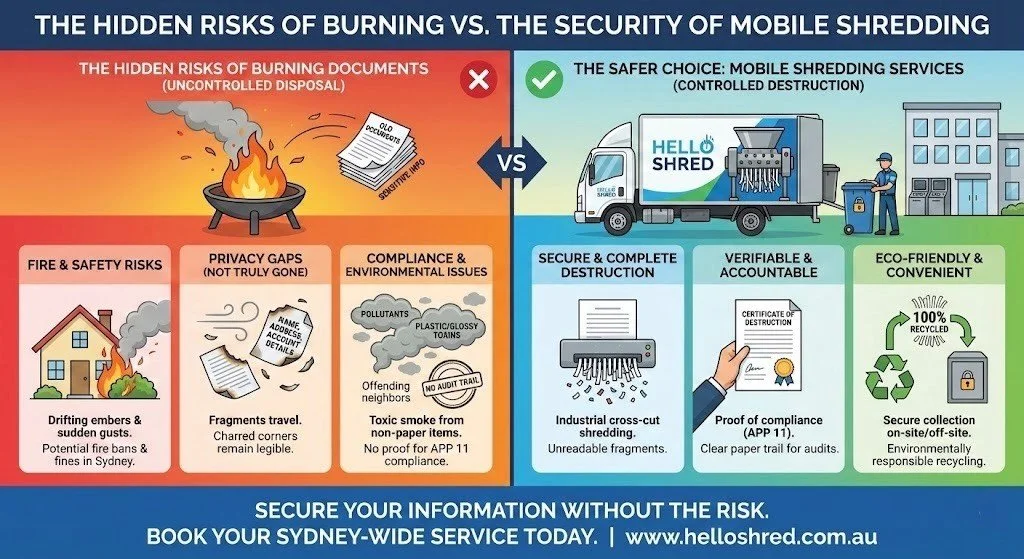
Mobile document shredding vs burning
Burning is uncontrolled disposal. Shredding is controlled destruction.
Mobile shredding brings the destruction process to your location, so documents don’t sit in a garage, boot, or shared office storeroom waiting for “one day”. The practical differences matter:
Security: Shredding reduces the chance of readable remnants or windblown fragments.
Accountability: A professional service can document what happened and when.
Convenience: Staff don’t lose time driving to drop-off points or trying to manage a DIY burn.
Environmental outcome: Shredded paper is typically directed into recycling streams rather than going up as smoke (your provider should be able to explain where material goes).
How off-site mobile shredding service works in Sydney
If your provider offers off-site document shredding, your documents are collected at your premises and destroyed later at a secure destruction facility, rather than being shredded in front of you.
Step 1 — Secure collection on your site
Most off-site programs start with secure consoles or lockable bins placed in convenient locations (for example, near printers, in records rooms, or behind reception). Staff drop paperwork in as they go.
Step 2 — Scheduled pickup and controlled transport
On service day, trained staff collect the filled containers and transport them to a destruction centre.
Step 3 — Destruction at a secure shredding facility
At the destruction centre, documents are shredded in bulk using industrial equipment designed for high volumes. This is where off-site shredding shines for larger clean-outs: it’s efficient, and it keeps workplace disruption low.
Step 4 — Confirmation and record-keeping
Businesses often need a paper trail to match their internal policy or satisfy auditors. Reputable shredding services like Hello Shred provide a certificate or written confirmation after destruction.
Also Read: The Certificate of Destruction: Why a Receipt Isn't Enough for Compliance Anymore
Step 5 — Recycling
Shredded paper is typically sent for recycling rather than disposed of as waste.
Who benefits most from mobile shredding services
In Sydney, mobile shredding is commonly used by:
Small and medium businesses clearing archives
Medical, allied health, and aged care providers
Legal practices and conveyancers
Accountants and bookkeepers
Real estate and strata managers
Households doing a clear-out before moving or downsizing
If it contains personal information, financial details, or anything you’d rather not see on the footpath, shredding is usually the sensible option.
What documents should you shred (not burn)?
People often underestimate what counts as “sensitive”. It’s not only passports and bank statements. Shred items like:
Old bills and statements
Tax and super documents
Payslips and employment records
Client files and intake forms
Printed emails with names, addresses, or account details
School and childcare paperwork
If you’re unsure, a good rule is: if you’d be uncomfortable handing it to a stranger, don’t burn it and hope for the best.
Ready to dispose of sensitive paperwork without the fire risk or guesswork? Request an instant quote and book Sydney-wide off-site document shredding with Hello Shred, with collection records and a certificate of destruction provided for each job.
Frequently Asked Questions:
1. Is it safe to burn documents at home in Sydney?
It’s rarely a good idea. Aside from fire risk, smoke from backyard burning can trigger neighbour complaints and may breach rules if you burn household waste or create excessive smoke.
2. Does burning documents fully destroy personal information?
Not reliably. Thick stacks often char on the outside while pages inside remain readable, and wind can carry away fragments mid-burn. If you’re trying to prevent identity misuse, you want a method that consistently reduces paper to unreadable particles, not one that depends on heat, airflow, and luck.
3. What is mobile document shredding and how does it work in Sydney?
A mobile shredding service comes to your address and destroys documents on-site or off-site, usually using a shredding vehicle. This reduces time in transit and keeps sensitive files under tighter control. For businesses, this also supports privacy practices that require secure disposal when information is no longer needed.
4. Do you provide a certificate of destruction in Sydney?
Hello Shred can supply written confirmation after a job, which helps with audits and internal record-keeping. If you’re disposing of client, employee, or patient information, ask what documentation you’ll receive and what details it includes (date, location, and method of destruction).
5. What’s the difference between on-site shredding and off-site shredding?
With on-site shredding, destruction happens at your premises, so documents aren’t transported intact to another facility.
Off-site shredding can still be secure, but it relies more heavily on transport controls and facility processes.