
How Long Should Australian Businesses Keep Records Before Shredding Them?
For most Australian businesses, the safest starting point is this: don’t destroy records until the required retention period has ended.
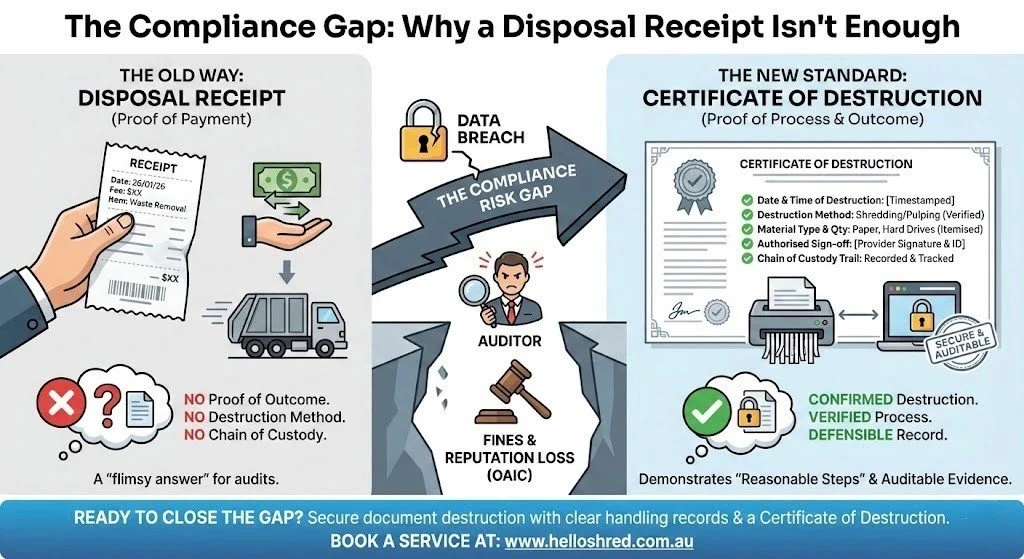
A disposal receipt tells you one thing with confidence: someone collected your materials and you paid for the service. It does not, on its own, prove what happened next. That gap is getting harder to ignore as privacy expectations tighten and audits become more evidence-driven.

In Australia, the Office of the Australian Information Commissioner (OAIC) makes it clear that organisations must take reasonable steps to destroy or de-identify personal information once it’s no longer needed (with specific exceptions). When the question shifts from “did you arrange disposal?” to “can you show the information is gone?”, a receipt is a flimsy answer.
Receipts usually list a date, a fee, and a rough description like “waste removal” or “document disposal”.
They rarely include itemised identifiers, verified destruction method, or who signed off on the process.
If a client asks for assurance, or an insurer asks how you handle sensitive records, you need more than a line on an invoice.
The point is not bureaucracy for its own sake. It’s about being able to explain, clearly and calmly, what you did and why it was appropriate.
Data breaches include loss, unauthorised access, or disclosure of personal information. Where serious harm is likely, organisations must notify affected individuals and the OAIC.
That context changes how “end-of-life” records are viewed. A misplaced archive carton or a decommissioned laptop sold with recoverable files is no longer just an operational hiccup. It can become a reportable incident, with reputational and financial fallout.
A certificate is designed to be evidence. It links your materials to a defined process and a defined result.
At a practical level, it should capture what was destroyed, when it happened, and how it happened. It should also connect back to your job reference or internal register, so you can match the certificate to the items that left your site.
Hello Shred, for example, states that a “Certificate of destruction” is supplied as part of its shredding bin service. That’s the kind of baseline documentation many organisations now treat as standard, not optional.
“Reasonable steps” often comes down to whether you can produce records that make sense to an outsider.
That’s where data destruction compliance becomes more about disciplined record-keeping. You need a clean trail that shows you controlled the materials and you chose a method that matched the sensitivity of the information.
A strong certificate typically includes:
Those details turn a statement into proof of destruction that can be checked and matched to your internal records.
Most mishaps don’t happen inside a shredder. They happen during collection, storage, and transport.
That’s why chain of custody documentation matters. It shows who had control of the material at each step, where it was stored, and when it moved.
When a question arises months later, that trail can be the difference between “we think it was fine” and “here’s the record”.
Paper records are relatively straightforward: destroy them so they can’t be reconstructed.
Digital storage is trickier. The right method depends on the device type, condition, and sensitivity.
That’s the tension captured in hard drive destruction vs data wiping. Verified wiping may be suitable in some contexts; physical destruction may be preferable when devices are faulty, the stakes are high, or you need maximum certainty.
Look for providers who can explain their process without hand-waving. Ask what gets recorded, how materials are tracked, and what happens if a seal is broken or an item is rejected.
If your provider can’t supply auditable destruction records, you may be left holding the risk.
Ready to clear out confidential paperwork without the admin headache? Book Hello Shred’s secure document destruction for a one-off collection or locked on-site bin service, with clear handling records and a Certificate of Destruction issued after shredding.
Also Read: Ecofriendly Paper Shredding: How Technology Facilitates Green Document Destruction
A certificate of destruction is a document provided by a shredding or destruction service that confirms materials were destroyed using a stated method on a stated date. Organisations ask for it because it’s evidence of an outcome, not just evidence of collection. This supports governance, customer assurances, and privacy obligations, especially where records contain personal information.
A receipt can support that you arranged disposal, but it rarely shows what happened to the information. If a breach occurs through loss or unauthorised access, the Notifiable Data Breaches scheme can require notification when serious harm is likely. Documentation that ties your materials to a secure method of destruction helps demonstrate you acted responsibly.
Look for date and time of destruction, destruction method, material type and quantity, job reference, and authorised sign-off. For IT assets, serial numbers and sanitisation results are valuable. Standards-based documentation practices often align well with what auditors want to see.
On-site shredding reduces transport risk and can provide immediate assurance, which some organisations prefer for high-sensitivity media. Off-site can also be appropriate if the provider controls collection, tracking, facility security, and reporting. The deciding factor is whether you can evidence secure handling from pickup to destruction, not where the blades are located.
Keep them in line with your retention policy, contractual requirements, and any regulatory expectations in your sector. Many organisations store certificates alongside disposal registers so they can respond quickly to audits, customer questionnaires, or incident investigations. If your business is regulated, third-party risk expectations may also influence how long you retain evidence.
For most Australian businesses, the safest starting point is this: don’t destroy records until the required retention period has ended.
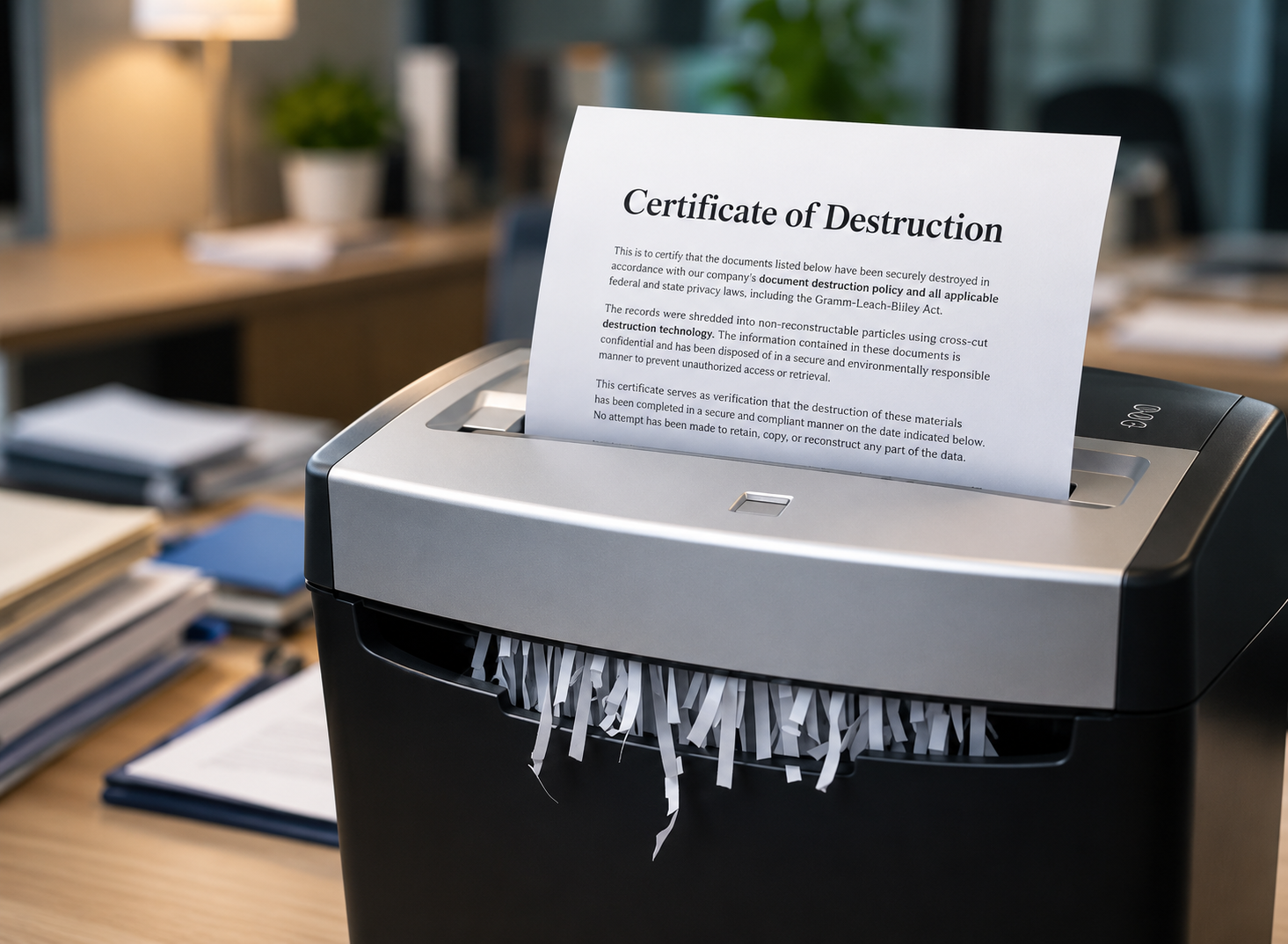
A Certificate of Destruction is one of the most important documents your business can hold after a shredding job. Yet many organisations misunderstand what it actually guarantees. Getting this wrong can leave you exposed during a compliance audit or a data breach inquiry under the Privacy Act 1988 (Cth). Here is a clear-eyed look at what the certificate confirms and, just as importantly, where its limits lie.
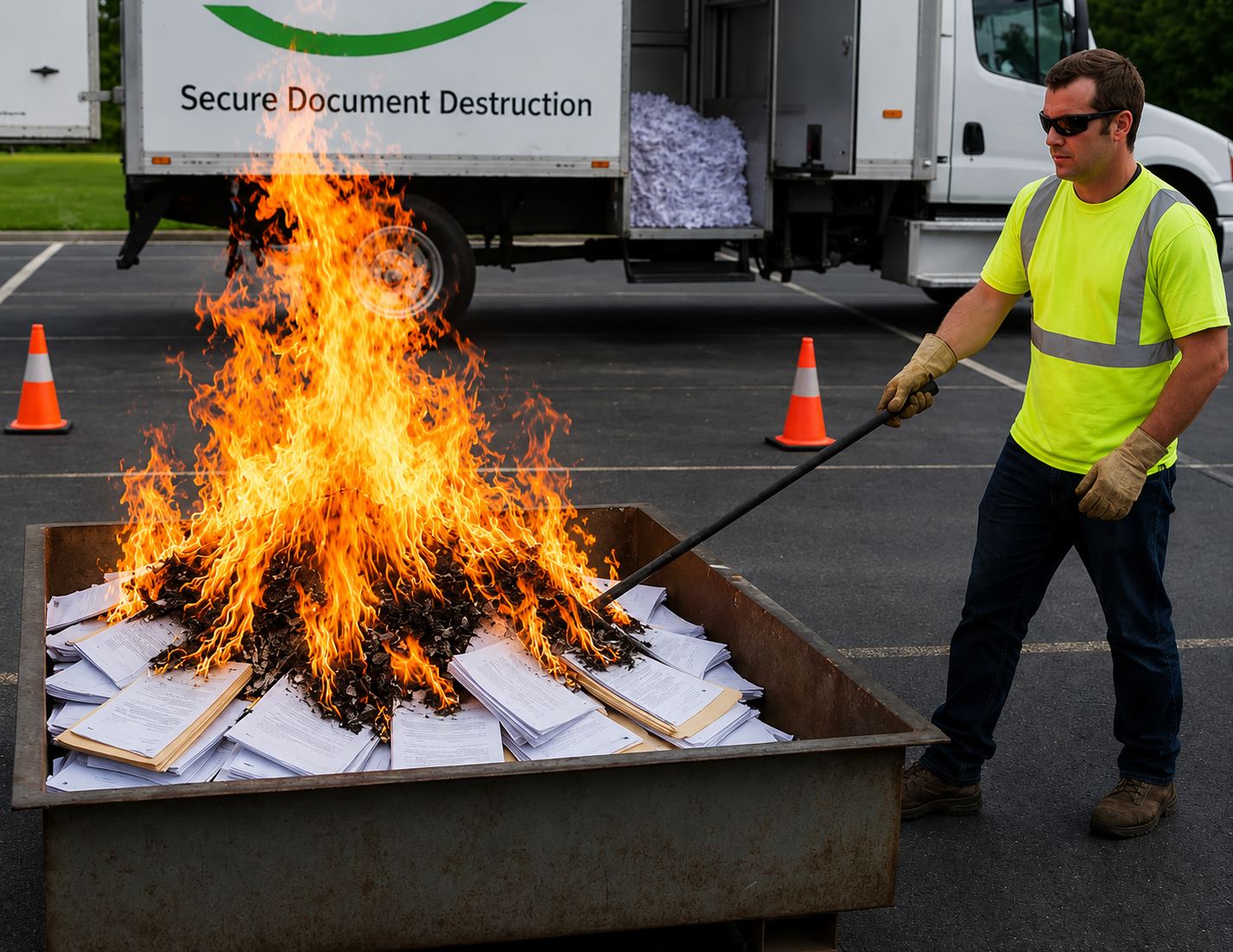
A quick burn can feel like the simplest way to clear out old paperwork. Yet for many households and small businesses, the safest approach is mobile document shredding services that destroy information on-site/off-site and leave far less to chance. Burning can create privacy gaps, safety hazards, and a mess of compliance headaches that only show up when it’s too late.
Book online in minutes. Pick your date and
we'll take care of the rest in a single visit.

© 2026 HelloShred | Privacy Policy | Website Designed & Developed by